
As small businesses increasingly rely on digital systems and sensitive data for their operations, identifying the perfect offsite backup solution becomes crucial. Today’s market offers a wide variety of data backup services, but understanding the key aspects of small business data protection ensures informed decision-making. It’s essential to invest in secure offsite data backup solutions that not only protect your business data from potential disasters but also enable quick recovery and continuation of your operations. Let us explore the frequently asked questions about offsite backup solutions for small businesses and understand their significance in ensuring business continuity.
Key Takeaways
- Importance of offsite backup for small businesses
- Cloud backup solutions for data protection
- Criteria for choosing the right offsite backup service
- Understanding pricing structures and service level agreements
- Cloud-to-cloud and private cloud offsite backup advantages
- Encrypted backup solutions for secure data storage
- Backup.Country as a reliable offsite backup provider
Understanding the Importance of Offsite Backup Solutions for Small Business
Small businesses often rely heavily on their data, making the need for a robust remote data backup system essential. Offsite backup solutions offer a crucial layer of protection against various incidents and disasters, ensuring business continuity and smooth operations. This section will delve into the importance of offsite data backup for small businesses and discuss the advantages it has over onsite backup approaches.
Why Small Businesses Need to Consider Offsite Data Backup
Offsite, or remote data backup, is an integral part of a comprehensive data protection strategy for small businesses. Cloud backup solutions play a fundamental role in addressing this concern, as they can help businesses recover from data-loss events quickly and effectively. This capability minimizes downtime and costly consequences that otherwise may arise due to information loss, theft, or damage. Therefore, incorporating offsite data backup services into the business workflow can help maintain both, the financial stability and reputation of a company.
The Impact of Data Loss and How Offsite Backups Can Salvage Situations
Data loss can occur due to various reasons, including human error, system failure, or cyber-attacks such as ransomware. The financial repercussions of data loss can be immense, with small businesses potentially losing over $100,000 per incident. Therefore, it is vital for businesses to invest in backup and disaster recovery solutions that can guarantee prompt recoverability, possibly within minutes, to reduce downtime and preserve their viability.
- Data backup and recovery: Quick and efficient recovery after a data loss event is crucial for maintaining business operations, and offsite backup solutions provide this ability.
- Business continuity: In the event of a disaster, offsite backups ensure that crucial data is safely stored, allowing businesses to resume operations swiftly.
- Cost-effectiveness: Most offsite backup solutions come with affordable pricing structures and a pay-as-you-go model, making it feasible for small businesses.
Comparing Offsite to Onsite Backup Approaches
When evaluating data backup methods, it’s essential to compare offsite and onsite approaches. While onsite backup solutions offer immediacy and easy access to data, they are vulnerable to physical catastrophes like fires, floods, or power outages. In contrast, small business data backup services utilizing an offsite strategy protect against potential localized disasters. By storing data in secure, remote locations, the risk of data loss due to physical incidents is greatly minimized, offering a much-needed safety net for businesses that rely significantly on their digital assets.
Exploring Various Types of Offsite Backup Solutions Available
With the increasing reliance on digital information, it has become crucial for small businesses to invest in data backup services that provide effective small business data protection. Offsite backup solutions come in various forms, ranging from cloud-based services to physical media transportation. In this section, we will explore some of the most popular offsite backup options available to small businesses.
Offsite backup solutions are critical to protect and preserve the essential data and ensure business continuity in the event of catastrophic data loss.
Different types of offsite backup solutions include:
- Direct cloud backups
- Private clouds managed by specialized backup vendors
- Traditional tape backups
- Evolving disk backups

Direct cloud backups involve backing up data to public cloud storage services like Amazon Web Services. This option allows businesses to take advantage of the flexibility, accessibility, and cost-effectiveness that cloud storage offers. However, businesses must closely monitor their cloud providers’ security measures and data management practices to ensure their confidential data remains protected.
Private clouds are another viable offsite backup solution, offering customized data backup services managed by specialized backup vendors. This approach often provides better control over business data and a tailor-made backup infrastructure, which can be more resilient against external threats.
Moving on to traditional tape backups, these remain a viable option for some businesses due to their cost-effectiveness and durability. However, the time-consuming nature of tape-based backup and restoration processes may not be suitable for businesses that require immediate data access and recovery.
Finally, evolving disk backups use hard drives or other types of digital storage media to physically transport data to offsite locations. While these backup solutions can be faster than tape backups and provide easy access to data, they may also introduce risks associated with physical media handling and transportation.
In conclusion, selecting the best offsite data backup solution for your business depends on various factors such as data volume, recovery time objectives, and budget constraints. Each backup solution offers its unique set of advantages and disadvantages, making it essential to weigh the pros and cons before committing to a specific method of small business data protection.
Criteria for Choosing the Right Offsite Backup Service
Selecting a reliable offsite backup service encompasses various factors, including data security, scalability, and a clear understanding of pricing structures. A comprehensive approach to evaluating these criteria helps small businesses find tailored solutions to meet their backup requirements.
Evaluating Data Security Measures in Offsite Backup Solutions

A robust offsite backup solution should prioritize data security. A secure offsite data backup must include encryption both at rest and in transit. In addition to encryption, service-level agreements (SLAs) that emphasize data integrity and availability for disaster recovery are essential.

Assessing the Scalability and Flexibility of Backup Services
As businesses evolve, their data storage needs grow, necessitating scalable backup options. Your chosen offsite backup service should accommodate increasing data volumes without backup limitations, allowing business operations to expand without constraints. With rapidly emerging technology, it is important to find flexible cloud backup solutions that integrate with your existing infrastructure and adapt to future changes.
Understanding Pricing Structures and Service Level Agreements
For small businesses, balancing expenses while maintaining sufficient backup services is of paramount importance. Transparency in SLAs enables predictable budgeting for data backup and recovery services, facilitating better decision-making. Establishing clear expectations regarding data recovery times and any additional hidden costs within each available plan ensures businesses choose solutions in line with their financial capacities.
| Consideration | Key Factors |
|---|---|
| Data Security | Encryption at rest and in transit, data integrity, SLAs emphasizing availability |
| Scalability and Flexibility | Accommodating data volume increases, supporting business expansion, flexibility to adapt to technological changes |
| Pricing Structures and SLAs | Transparent pricing, predictable budgeting, understanding data recovery times, hidden costs |
The Role of Cloud Backup Solutions in Offsite Data Protection
With the increasing reliance on digital data, the significance of cloud backup solutions in offsite data protection has grown exponentially. By merging ease of implementation with cost-effectiveness, cloud backup solutions provide businesses with secure and manageable offsite data backup options to assist in data backup and recovery efforts following an incident.
Cloud backup solutions operate on a variety of platforms, such as public and private clouds. These diverse platforms offer companies tailored solutions depending on their specific needs and level of security requirements. As a result, cloud backup solutions have become vital components of secure offsite data backup and recovery strategies for businesses of all sizes.

Public cloud
backup providers offer infrastructure and services that can be accessed through the internet, providing adaptability and often lower costs. However, they may lack the degree of data security and privacy some businesses require.
Private cloud
backup services, on the other hand, provide dedicated and more secure environments for companies with stringent security and compliance requirements.
Moreover, cloud backup solutions allow businesses to store critical information in geographically distributed data centers, further enhancing the protection against potential data loss due to localized events such as natural disasters or cyberattacks. This feature is especially valuable for businesses located in regions prone to such events.
Cloud backup solutions offer security, flexibility, and scalability, making them an essential component of any robust offsite data protection plan.
In conclusion, incorporating cloud backup solutions into an offsite data protection strategy can significantly enhance a business’s ability to recover from data loss incidents swiftly. By utilizing a combination of public and private clouds or adopting a hybrid approach, businesses can ensure the safety and accessibility of their data and maintain seamless operations, even in the face of unforeseen challenges.
Importance of Scheduled Backups and Automation in Data Protection Strategy


In the world of data backup and recovery, automation is becoming increasingly essential for small businesses. Automated backup services provide efficiency, reliability, and continuity, which are key components in any business’s data protection plan.
Automation eliminates human errors and ensures continuity for your small business.
Continuity planning, as part of an overall data protection strategy, requires regular scheduled backups. These backups should meet the specific recovery point objectives set forth in the business continuity plan.
- Consistency: Automated backups maintain a regular schedule, ensuring that all changes and updates are safely and systematically stored.
- Reliability: Automated backup services store the data securely and are designed to guarantee optimum functionality.
- Efficiency: Automated systems save time and effort, freeing up staff members to focus on other essential tasks.
| Backup Method | Advantages | Disadvantages |
|---|---|---|
| Automated Backup Services | Consistency, reliability, efficiency | Requires careful setup and monitoring |
| Scheduled Manual Backups | Flexibility, control | Time-consuming, prone to human error |
| Ad-hoc Manual Backups | Familiarity with data storage location, control | Irregular, risk of incomplete data recovery |
In conclusion, incorporating automation and scheduled backups into your data protection strategy is critical for maintaining business continuity. While manual backups can offer a sense of familiarity and control, they lack the consistency, reliability, and efficiency that automated backup services provide. Ultimately, ensuring that your small business has a robust and reliable backup solution is crucial for long-term success.
Benefits of Cloud-to-Cloud and Private Cloud Offsite Backup
When considering an effective data backup strategy, small businesses can benefit significantly from secure offsite data backup options. Cloud-to-cloud and private cloud backups offer unique advantages in safeguarding vital data. The cloud backup solutions presented in this section could bolster your business’s data resilience against potential cyber threats and other unforeseen challenges.

Cloud-to-cloud backup protects data in the event of a singular cloud service failure, ensuring your business does not experience data loss due to issues with a sole cloud provider. Storing backup data with multiple cloud service providers increases redundancy and offers quicker recoverability in case of disruption affecting any particular cloud service. In essence, you mitigate the risk of service failure through diversified cloud storage.
On the other hand, private cloud offsite backup provides businesses with more control over their remote data backup. These solutions operate through managed data centers run by specialized service providers, effectively securing your valuable data offsite. Private cloud backups offer a higher level of customization, enabling you to scale services according to the evolving needs of your business.

To better illustrate the benefits of these backup options, compare their features in the following table:
| Cloud-to-Cloud Backup | Private Cloud Offsite Backup | |
|---|---|---|
| Protection Against Singular Cloud Service Failures | Yes | No |
| Customization | No | Yes |
| Control Over Remote Backup | No | Yes |
| Scalability | Dependent on cloud providers | High |
In conclusion, both cloud-to-cloud and private cloud backups offer advantages when securing your small business’s critical data. Weighing the features of each backup option according to your specific business needs will lead to an informed decision that ultimately improves your overall data protection strategy and bolsters business resilience.
How Offsite Backups Aid in Disaster Recovery and Business Continuity
In the realm of business continuity planning, offsite backups are a linchpin that cannot be ignored. Efficient backup and disaster recovery solutions that utilize offsite storage can be the key to safeguarding against catastrophic data loss. By having a well-organized offsite backup strategy in place, businesses can quickly resume operations following a crisis by retrieving their secure backups from remote locations.

When it comes to incorporating offsite backups within business continuity planning, there are a few considerations to bear in mind. Primarily, businesses must prioritize the security and accessibility of their stored data. Simultaneously, they should assess the scalability of their backup solution, ensuring it can grow with their business as its data needs evolve.
“Offsite backups are a critical component of a robust business continuity plan, providing organizations with the security and confidence needed to withstand and quickly recover from data loss events.”
Offsite backups contribute significantly to effective backup and disaster recovery solutions as they offer the following advantages:
- Protection against physical disaster and theft
- Swift recovery and minimized downtime
- Compliance with data protection and industry-specific regulations
- Data redundancy and offsite storage for multiple backup copies
Businesses should regularly test their offsite backups, ensuring a seamless experience during potential data recovery scenarios. Regular testing allows for ongoing validation of the backup solution’s effectiveness, in addition to identifying areas in need of improvement within their overall business continuity planning strategy.
Identifying Offsite Backup Solutions That Fit Your Business Infrastructure

Selecting an offsite backup solution that aligns with existing business infrastructure is vital for effective data protection. Small businesses benefit from scalable backup options that ensure comprehensive coverage of their entire infrastructure, including various operating systems and computing environments. To make an informed decision for your business, consider comparing small business data backup services in terms of their compatibility, features, security, and pricing.

As a starting point, we have compiled a list of criteria to compare various offsite backup solutions:
- Compatibility with your existing hardware and software
- Customization options to suit business-specific requirements
- Data encryption at rest and in transit
- Scalability to grow with your business
- Transparent pricing structures and service level agreements
Offsite backup solutions can be grouped into three main categories:
- Cloud backup solutions
- Managed backup services
- Physical media transportation
Each of these backup options can provide various levels of compatibility, features, security, and pricing. To help you compare the options, we have created the following table:
| Backup Solution | Compatibility | Features | Security | Pricing |
|---|---|---|---|---|
| Cloud Backup Solutions | Works with most operating systems and software | Automated backups, easy file restoration, remote access | Data encryption in transit and at rest | Pay-as-you-grow pricing, subscription-based models |
| Managed Backup Services | Customizable to work with specific hardware and software | Backup monitoring, reporting, and management | Data encryption, secure facilities, compliance support | Fixed monthly fees, additional charge for data recovery services |
| Physical Media Transportation | Compatible with various storage types, including tape and disk | Offsite storage, scheduled pickups, secure transportation | Secure facilities, controlled access, monitoring | Fixed monthly fees, additional charge for retrieval and delivery |
By comparing the various small business data backup services and examining their compatibility, features, security, and pricing, a small business owner can effectively identify the offsite backup solution that best fits their business infrastructure.
Comparing Public, Private, and Hybrid Cloud Backup Models
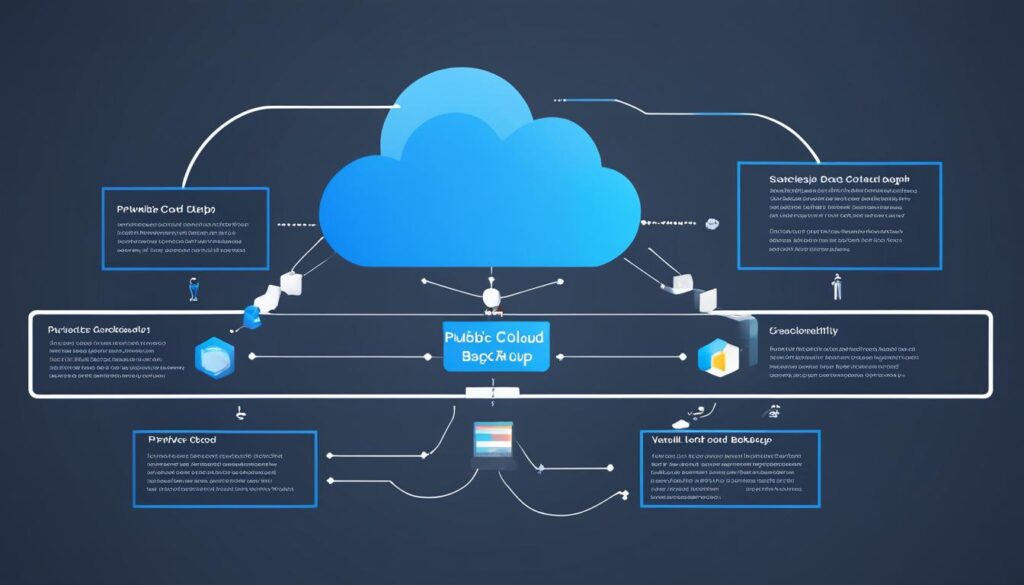
As businesses seek reliable cloud backup solutions, it is essential to evaluate the benefits of public cloud storage, private cloud services, and hybrid cloud backup models. Each model offers unique advantages tailored to specific business needs, and understanding their differences can inform your decision-making process.
Public cloud storage offers cost-effectiveness and flexibility, making it an appealing choice for businesses looking to save on infrastructure costs. However, because the infrastructure is shared with other users, it may not sufficiently cater to companies with stricter security requirements. Popular public cloud platforms include Amazon Web Services, Microsoft Azure, and Google Cloud.
On the other hand, private cloud services deliver customized security and control over your hosted infrastructure. Ideal for organizations with strict data governance protocols, private cloud users benefit from increased privacy and tailored infrastructure management. Private cloud storage from providers like VMware Cloud and IBM Cloud enables businesses to maintain a dedicated space for their storage needs.
The hybrid cloud backup model combines the best of both worlds, offering a mix of cost-effective public cloud services and dedicated private cloud resources. This balance allows businesses to benefit from the flexibility of public storage for less-sensitive data, while retaining the security advantages of a private environment for more critical information.
Each cloud backup model offers distinct advantages, and the ideal option ultimately depends on your organization’s specific requirements. To better illustrate the key characteristics of these models, we have compiled a comprehensive table comparing their various features:
| Features | Public Cloud Storage | Private Cloud Services | Hybrid Cloud Backup |
|---|---|---|---|
| Cost Efficiency | High | Low | Medium |
| Scalability | High | Medium | High |
| Customization | Low | High | Medium |
| Data Security | Medium | High | High |
| Control | Low | High | Medium |
| Implementation | Easy | Complex | Medium |
In conclusion, businesses must evaluate their data security, scalability, and cost requirements when choosing between public, private, and hybrid cloud backup models. By understanding the strengths and limitations of each option, organizations can make informed decisions that best align with their infrastructure and security needs.
Securing Your Small Business Data with Encrypted Offsite Backups
With the rapid rise in cyber threats and the increasing reliance on data, it is crucial for small businesses to adopt secure offsite data backup strategies. Encrypted backup solutions play a vital role in ensuring the safety of sensitive information. They protect data in transit and at rest in remote locations, as well as reducing the risk of unauthorized access.
Encryption constitutes the backbone of secure offsite data backup by safeguarding sensitive information from cybercriminals, ensuring that small businesses thrive even in this increasingly digital age.
Choosing the correct encrypted backup solution is essential to protect not only your business data but also your reputation and overall business success. To help you in making an informed decision, we have outlined the main types of encryption mechanisms employed in offsite data backup services:
- Client-side encryption
- Server-side encryption
- Hybrid encryption
Each encryption mechanism offers different degrees of security, and finding the most suitable one depends on your specific business needs and infrastructure. To gain a comprehensive understanding, let’s delve into the specifics of these encryption mechanisms:
| Encryption Mechanism | Description | Strengths | Weaknesses |
|---|---|---|---|
| Client-side Encryption | Data is encrypted locally on the client’s device before being transmitted to the offsite location. | Offers the highest level of encryption and security. Only the client holds the decryption key. | Increased processing overhead and slower operation. Loss of decryption key may result in permanent data loss. |
| Server-side Encryption | Data is encrypted at the server level by the offsite backup service after being transmitted. | Less processing overhead on the client-side. Often built-in and managed by service providers. | Service providers hold the decryption keys, increasing possible vulnerability to security breaches. |
| Hybrid Encryption | Combines both client-side and server-side encryption for enhanced security. | Offers additional layer of protection. Supports efficient encryption of large amounts of data. | Requires additional setup and management. Loss of decryption key may result in permanent data loss. |
With a clear understanding of the encryption mechanisms available, you can now make an informed decision when selecting secure offsite data backup services that feature encrypted backup solutions. Prioritizing data protection today will go a long way in securing the future of your small business.
Call to Action: Choosing Backup.Country for Your Offsite Backup Needs
As a small business, you know the importance of safeguarding your valuable data and ensuring seamless operations within your organization. With many offsite backup options available, it can be challenging to determine the best fit for your specific needs. Backup.Country emerges as the leading choice for small businesses, offering comprehensive SAAS-based backup services.
Emphasizing data backup and recovery, Backup.Country provides you with a secure, reliable, and cost-effective solution. Your data is encrypted and stored in state-of-the-art facilities, ensuring its safety and accessibility at all times. This gives you the peace of mind to focus on growing your business without worrying about data loss or recovery.
If you’re seeking a trusted partner for your small business data backup services, look no further than Backup.Country. We are dedicated to providing you with the high-quality offsite backup service your business deserves, guaranteeing prompt recovery times and seamless integration with your existing infrastructure. Secure the future of your small business with Backup.Country.
FAQ
Why should small businesses consider offsite data backup?
Small businesses rely heavily on data for their daily operations, making it critical for them to have a robust remote data backup system in place. Secure offsite data backup helps businesses recover quickly from data-loss events and minimizes downtime, which could potentially lead to significant financial losses.
How do offsite backups differ from onsite backups?
While onsite backups provide immediate accessibility to data, they are vulnerable to physical catastrophes such as natural disasters or theft. Offsite backup solutions, on the other hand, offer an added layer of protection by storing data at a remote location, making it more resilient to localized disasters.
What types of offsite backup solutions are available for small businesses?
Offsite backup solutions range from cloud-based services, such as direct cloud backups to Amazon Web Services, to physical media transportation like tape and disk backups. Additionally, private clouds managed by specialized backup vendors can also be used for data backup and recovery.
How can small businesses evaluate data security measures in offsite backup solutions?
Secure offsite data backup solutions should include encryption both at rest and in transit, along with service-level agreements (SLAs) that emphasize data integrity and availability for disaster recovery. Businesses should assess the security features offered by different solutions to ensure adequate protection of their sensitive data.
What should be considered when assessing the scalability and flexibility of backup services?
Small businesses should look for scalable backup options that can accommodate their evolving data storage needs and ensure seamless operations as the business grows. This includes finding a service that can comfortably handle increasing data volumes without imposing limitations on backup capacity.
Why is understanding pricing structures and SLAs important for small businesses seeking offsite backup solutions?
Clear and transparent pricing structures allow small businesses to predict the costs associated with data backup and recovery services. Additionally, SLAs outline the expected data recovery times, which helps businesses budget and plan for potential data-loss events.
How do cloud backup solutions play a role in offsite data protection?
Cloud backup solutions offer secure and manageable offsite data backup options, combining ease of implementation with cost-effectiveness. These solutions operate on various platforms, such as public and private clouds, helping businesses recover operations quickly after a data-loss incident.
Why is automation important in data backup and recovery strategies?
Automation in data backup and recovery helps eliminate human error and ensures continuity. Scheduled and automated backup services also fulfill specified recovery point objectives within a business continuity plan, making data protection more efficient and reliable.
What are the benefits of cloud-to-cloud and private cloud offsite backup solutions?
Cloud-to-cloud backup solutions provide protection against single cloud service failures, while private cloud backup grants businesses control over their remote data backup through service providers’ managed data centers. Both options offer distinct advantages for small businesses seeking secure offsite backup solutions.
How do public, private, and hybrid cloud backup models compare?
Public cloud storage often offers cost savings and flexibility, while private cloud services provide customized security measures. Hybrid cloud backup combines the benefits of both options, ensuring dependability and cost-effectiveness, allowing small businesses to choose the best backup model for their needs.
What is the importance of encryption in offsite data backup?
Encryption helps protect sensitive data while it is being transferred to offsite locations and while it is stored remotely. Encrypted backup solutions offer peace of mind by ensuring that unauthorized access to the data is prevented, keeping it secure from potential threats.
